Showing posts with label Steven Marcus Releford. Show all posts

Friday, October 14, 2022

THIRTEEN - Comedy


WHY THIRTEEN?

There are hundreds of stand up comedy shows in L.A. Netflix shoots dozens of one hour comedy specials a month. The big clubs like The Comedy Store, Laugh Factory and The Ice House are full every weekend. Comedians are obviously on those stages getting noticed, getting paid, and moving up in Hollywood, right?

Not exactly.

For more than a dozen years I've interviewed dozens of stand up comics. Although they are all different people with unique imaginations and their own style of comedy, stories they tell about the evils of Hollywood are often copies of each other when it comes to the abuses they suffer to get stage time. Extortion is common. Working for free is the norm. 

For female comedians it's worse. They often are asked to exchange sex for stage time and/or payment. Sexual harassment doesn't even describe it. Dating the host of a comedy show to get stage time can be mandatory for most women. To even be a part of "the scene" in stand up comedy if you are young usually means hooking up with other comics, if you want to move up.


Steven Marcus Releford, the headliner for THIRTEEN

Human greed is also a factor. In real life you work a job, get paid for it, and with more education and experience you move up and get paid more. Some people might work internships in college. Others work for free to get experience before a new career. At one point you will get paid for working a job, that's the logic. Not in Hollywood.

Stand up comics often pay for stage time. Gasoline, parking, and traffic tickets all take a chunk of money. After that they might buy two drinks to put their name in a raffle to go up or even pay $5 to perform for five minutes. Some clubs are generous. Any comedian going up only buys two drinks for the privilege. They cost $10 each of course. 

The worst are bringers. The producer/host demands each comic bring ten people to perform. Out of the $200 the comedian brings in they might get $20, while the bringer host happily brings in their friends to perform, too, without the burden of bringing anyone. It also does the beginning stand up comic no favors with their peers, who will despise the performer for performing in a bringer, even if they were paid. 


It's time to celebrate Halloween early...

If a comedian sees any money from their work early on, it will probably be out of a bucket or hat the producer of the show passes around the audience to pay the performers. Here's your paycheck...$3.72, plus dryer lint. This is after all the hours comedians spent driving to the event, before they get a parking ticket because L.A. screwed up the signs again.

Breaking into stand up comedy in Hollywood also means joining social cliques. Remember the cool kids in high school that looked down upon you and could ruin your social status with a word or lie? They are alive and well, producing and hosting comedy shows. Make friends and you might move up. Make someone jealous and you've made an enemy to your career. Refuse to date the wrong person and they'll make sure you never work in any show they are on. Nobody will defend you if that person is a producer or host known for abusing others...they need the stage time.
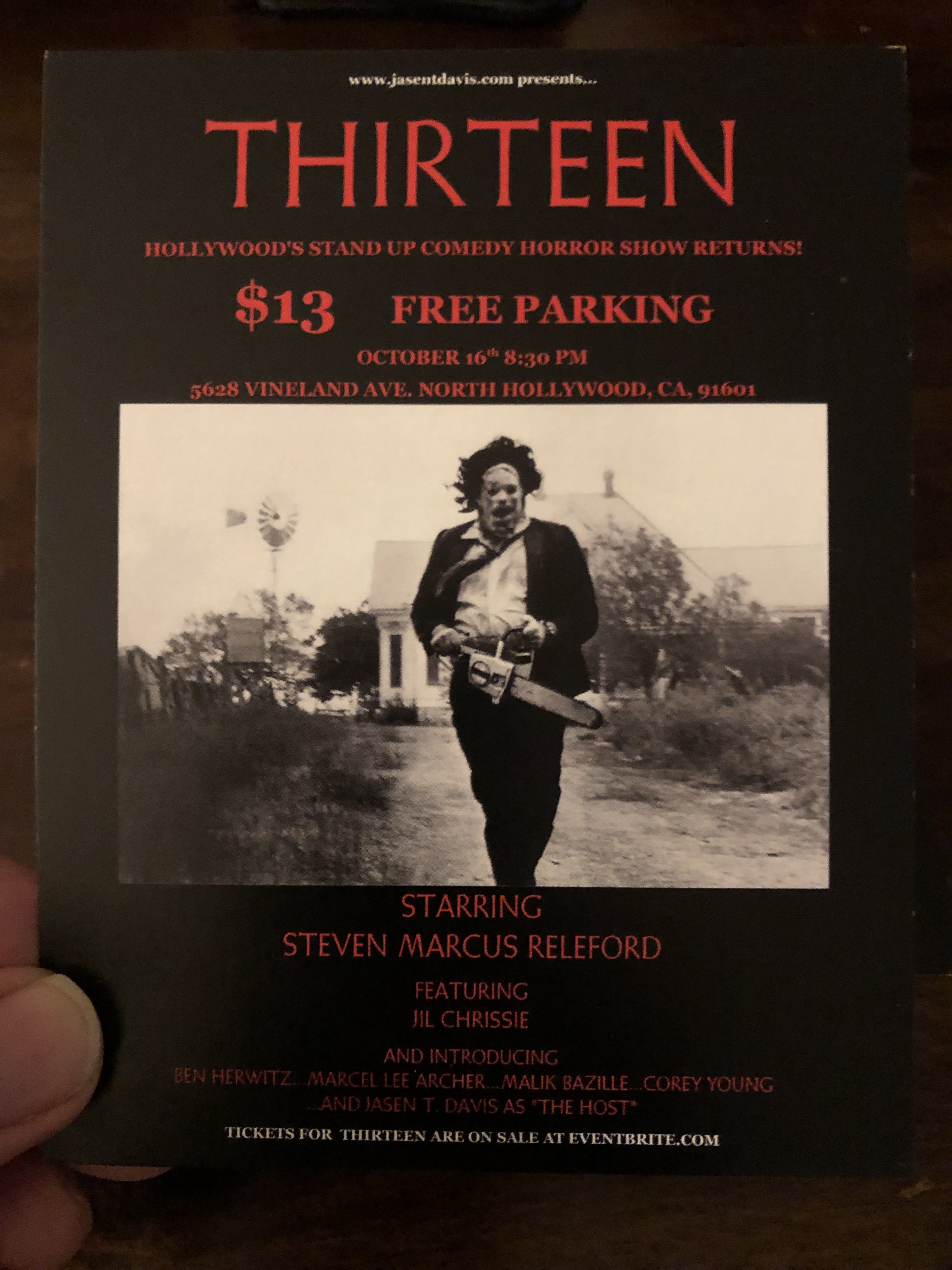

Holding a flyer for the show.

If you don't fit in because don't have the exact, specific, perfect personality to get along with the covert egotistical narcissists that infect any healthy social scene, you don't move up and you don't get stage time. Open mic nights can be miserable for anyone new, even if they are damn good. Every comedian in the audience is a potential rival, waiting to hold back laughter to hurt their competition.

Comedians MUST get stage time. Theater gives any actor hours upon hours of experience thanks to rehearsals, technical blocking and performance. Film repeats scenes and shots endlessly. An actor may say the same lines fifty times in one day. Stand up comedy only has the stage plus the audience. They have to get up there to get a measly 3-5 minutes, after hours of waiting. At the end of the month an amateur stand up comic might only perform for an hour, and they are often paying to do it. 


Releford on the mic, entertaining the audience.

THIRTEEN is a safe haven from all that useless chaos stand up comics usually deal with. Comedians get to work in a professional environment where they are respected, paid for their work, and not exploited. There will also be diversity, so that everyone is equally represented. While this might be common sense to the reader, it's brand new facts to some people running stand up comedy shows throughout California.

Guests at the THIRTEEN will notice the improvement in the performance of the comedians entertaining them. Great money means greater morale. Happy people are funnier to be around, and get bigger laughs from the audience because of their attitude. Paying stand up comics also means the audience gets the best performance for their buck because our show hired a person worth paying. They are, after all, professional comedians, not amateurs. 


Enter if you dare.

Another big influence is theater, specifically The Grand Guignol Theatre of Paris, France, more than a hundred years ago. Normally a stand up comedy show is just a comedian doing comedy until they bring up more comedians to do the same. There is nothing wrong with this. A variety show featuring comedians along with other artists using music, magic, improvisational comedy and even dancing is an experience worth paying to see, especially one like ours with a gothic, macabre sensibility. 


A prop from the comedy horror show THIRTEEN.

Theater has a resounding importance across time and space because of humanity. Plays written hundreds and thousands of years ago are still performed today, and still matter. When the electricity stops and it's just fire and humans, theater will be there, as it has always been. Stand up comedy is theater. It's also speech, film acting technique and properly done, like a funny conversation with somebody entertaining at a bar. It doesn't need CGI to succeed. Fake blood helps. 


Some posters for The Grand Guignol Theatre of Paris, France, from more than a century ago.

The Grand Guignol was simply a theater in France, and a style of drama, that was innovative, bloody and violent. Gore isn't new to the stage, just watch Shakespeare's Titus Andronicus or Macbeth. Then watch The Little Shop of Horrors and Sweeney Todd. Add elements of horror and science fiction, like Dracula, Frankenstein plus The Cabinet of Dr. Caligari and you have the essence of Grand Guignol Theatre.


Audiences in the early 1900's saw shocking displays of blood, severed heads, scientific experiments gone wrong, tyrannical government tortures, executions, vampires, murder, madness, maniacs, werewolves and other dark subject matter worthy of modern Netflix Halloween specials, slasher flicks and Twilight Zone episodes. They were shocking senses and pushing boundaries, paving the way for horror and sci-fi films decades later. It is no mystery why Grand Guignol persists to this day, with troupes like The Molotov Theatre Group espousing it's gory glory. 

Stand up comedy vernacular fits right in with the ghoulish visualizations and horrific concepts The Grand Guignol Theatre espoused. Comedians "die" on stage, or they "kill." They "bomb" onstage, or they "slay" the audience, who were "dying of laughter." They "murder" the crowd. Even the end of joke is violent...a "punch line." Bomb too many times in Hollywood, if you are famous, and your career is "dead."


Our show is a theater production including horror and humor, with comedians appearing throughout to keep us all laughing. As THIRTEEN goes on we can add new acts, live music, belly dancers breathing fire, horror improv comedy and whatever it takes to give an audience their money's worth in an original way through a traditional method...live theater, which never dies. Please donate at our gofundme, if you can. We plan to expand, hiring more people, different acts and innovating our live show as time goes on. 

So please join us at THIRTEEN. We've chosen the perfect lineup for your entertainment. The price is right and parking is free. Halloween is right around the corner, and our show is the perfect place to turn up to celebrate such a tenebrous season. Sure, The Host of the show is a little crazy, and by the end of the evening there will be blood. Our comedians are complete killers. You'll never forget the humor, as long as you live! After all, there is no slaughter without laughter.

YOU CAN BUY TICKETS FOR THIRTEEN HERE AT EVENTBRITE

YOU CAN DONATE TO ESTABLISH A VENUE FOR THIRTEEN HERE AT GOFUNDME

Tuesday, September 20, 2022

"Y'ALL HAD TO BE HERE" PART III - Comedy

This is part three of an interview with Steven Marcus Releford, Niles Abston and Johnny Mac about Y'ALL HAD TO BE HERE, a show combining comedy, improv, podcast interviews and an inside look at the lives of comedians that goes beyond mere stand up to entertain the audience with layers of humor and commentary from a team of who knows what they're talking about. It's an education for anyone who loves the business of stand up comedy and intellectual entertainment for everyone else.

If you are interested in seeing more from the very funny people involved in this project check out BASEMENTFEST, a three day event featuring talent from all over Los Angeles in a venue unique from the rest. The comedic extravaganza will have performers from Y'All HAD TO BE HERE and more with a party atmosphere only personalities as powerful as Niles Abston, Steven Marcus Releford, Johnny Mac, Arthur Hamilton and their fellow comedic performers can provide.


Just like any good TV show, many audience members could never understand the pain, sweat and tears it took to get to the point where Donald Glove could do a show with as much depth as Atlanta. 

Niles Abston: You have to look at all the groundwork Donald Glover has done to make white people feel safe around him. He is the safest bet for white people when it comes to a black guy. He's "The Black Friend" to white people. He's funny, he can rap, he's handsome...he's been in so many spaces from NYU to improv comedy to 30 Rock, to Community where he's collected all these white tokens in a way so it's like, "Alright, we'll let you make a TV show." And then it's like, "Woah! That's not the show we want you to make, but we like you so we'll let you do it.

Steven Marcus Releford: And it's making money.

Niles Abston: And it's making money. He's been able to do what a black film maker has never been able to do on television because he's been palpable to white people for so long.

He's had to make sacrifices to. It's on YouTube. Chevy Chase...

Niles Abston: He was so mean to him!

Oh yeah. Even Chevy Chase thought the writing for Donald Glover was terrible because he was portrayed as a dumb jock. There's also the problem of how Chase thought it was ok to use the n-word in front of Glover. I'm sure the young man was just sitting in the middle of all the controversy thinking, "I don't want to make any waves." He had to suffer without saying anything to move up in Hollywood.

Niles Abston: That's what being black is. Picking your battles. "I'm not going to say anything about this because down the road I want to direct." I've been told this: "It only takes black people ten seconds in this industry to be 'hard to work with,'" and once the word "difficult" gets used to describe you, especially black women, now people don't want to work with you. Donald Glover was like, "I'm not going to complain over some TV role, I'll just leave." He wanted to make a crazy TV show one day. It's crazy how we have to think like this. White people don't have to do that. They can just live in the current moment.

I've also been told about how there's a lot of pressure on black people from Hollywood executives sometimes to be a stereotype. To be more black. That's part of the reason John Amos left Good Times. The show became a parody of itself and the real people the writing was supposed to portray.

Johnny Mac: And the fucked up thing is that the executives are probably arguing, "But that's what people want." The fact is the audience is black, Asian, white...everybody. So a white executive might say, "Our white audience..." and if they put a black or Asian show on TV, only those groups would watch it. It's actually that the white executive wouldn't watch it. A middle aged white man is telling me that young white people won't watch a show. "Only black kids will watch this show," he thinks that. It's not the truth. That's why you need representation in there, or you need to understand what the big picture is.

Steven Marcus Releford: That's what's cool about stand up. You can tell your story any way you want to. You'll tell a joke, and it works, for either crowd, but the laughs are different, right? It's because it's still a laugh, and a truth, that needs to be heard. That's the same thing with Atlanta, it's like, "Oh, we didn't want you to make this type of show, but we've already green lit it and people love it." It's real. It's truthful shit. I'm laughing in a way that's different.

Niles Abston: He couldn't have pitched that type of show. And everything is based on the pitch instead of the actual product.

He also makes fun of both sides. He makes fun of African American culture and white racist culture.

Niles Abston: Right, from the things he knows, though. It's a genuine place. He's not making up a stereotype to make fun of. If a white person is making fun of black people it's like, you don't even know anybody who acts like that. What are you talking about?

It feels sometimes that Glover is also being very meta. He's making fun of stereotypes...and also making fun of television stereotypes, not the real person or predicament.

Johnny Mac: He makes fun of the white perception.

Niles Abston: Uh huh. He's a genius.

There's a part in his Childish Gambino video for "This is America" where he's dancing shirtless on a car in a parking garage. The camera pulls back. What's the color of the garage and everything around him? It's white. He's absolutely surrounded by a white structure. He's in a giant white parking garage in a white structure with layers going up, and he's still near the bottom.

Niles Abston: That's hilarious! I've never thought about it that way.

It's very subversive, if that's what he meant. He loves David Lynch, he also loves Kubrick. I saw that and thought, "That's how he feels. Look where he works."

Niles Abston: And he had to do so much to get to that point. It's almost like he became a rapper to make that show because he knew one good way for a black dude to get famous is to become a rapper. He did that stand up thing. He did stand up before rap.

Johnny Mac: He did improv, sitcom, rapper, movie star...and then they are like, "What do you want to make?" And he's like, "Fucking finally."

Niles Abston: That's the thing, he totally cut to the front of the line because of rap. It's because he got popular in another place. The only person to ever do that was backwards, like Will Smith got popular in rap and then went to TV. Donald Glover had to do the reverse, which is honestly stupid when you think about it.

Talking to all of you also makes me realize that even back then, Will Smith had to rap as if he was at a Def Comedy Jam because of the popular stereotype. "There's no need to argue, parents don't understand," sounds like a punch line.


You can buy tickets for BASEMENT FEST right here.

Check out more of Y'ALL HAD TO BE HERE by following this link.